Disney made a cheap copy of Star Wars; and violated every rule in the galaxy!
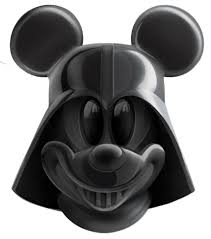
In 2012, George Lucas sold his company, Lucasfilm, to The Walt Disney Company for $4.05 billion. Robert Iger, Disney CEO, immediately put plans in motion resetting Star Warscanon1, including the elimination of the Expanded Universe2. Additionally, he promised a sequel trilogy concluding the Skywalker saga. However, Bob had no intention of following George’s story (Child). Rebranding Star Warsin Disney’s image was his goal. In a race to recover the billion-dollar investment, he set a release date without having a story (Handy). The result is a fanfiction3 trilogy with gratuitous pandering to the Star Warsminions (Rogers). Although Disney successfully merchandises nostalgia, The Force Awakens(TFA) violates the essential Star Warscontinuity of design, story and logic.
THE QUICK AND EASY PATH
The November 2014 teaser trailer of TFA highlights Iger’s fast-track production schedule and his merchandising goal. Initially, Iger wanted a Star Warsmovie released every two years. Kathleen Kennedy, Lucas’ hand-picked president of Lucasfilm, raised her concerns. “I was the one raising my hand and saying, ‘Ah-ah-ah, might be a little difficult, as nothing’s in place, including a script, a director, a plan” (Handy).
The TFA trailer teased images of Storm Troopers, Twin Ion Engine (TIE) Fighters and the Millennium Falcon as fanservice4. But all three iconic ships represent Iger’s rejection of Lucas’ vision and philosophy of ‘constant innovation’4. George intentionally made design changes to technology, planets and characters building a sense of time and place for his galaxy far, far away.
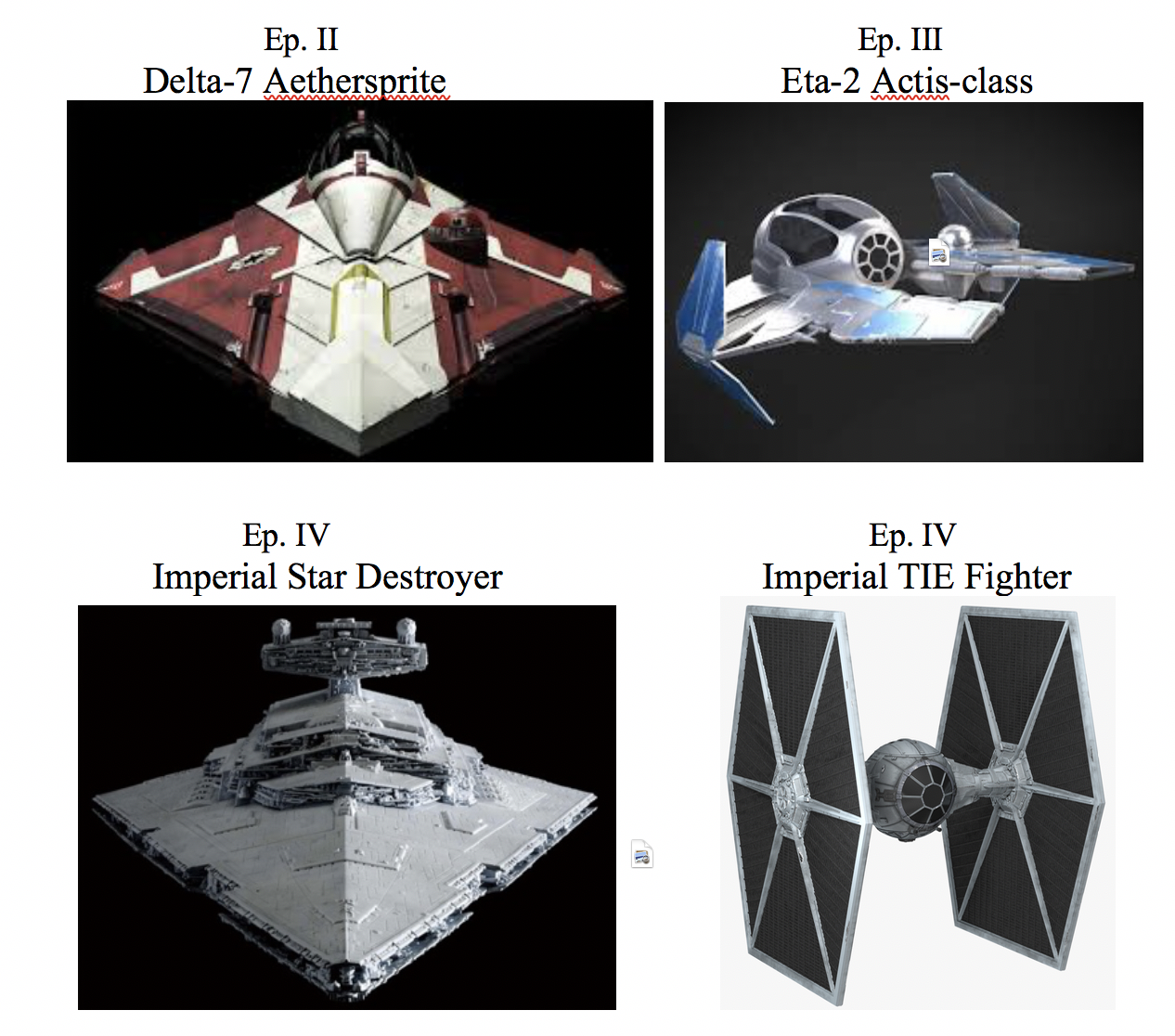
The Jedi Starfighter’s evolution into the Imperial TIE Fighter is one example of how Lucas used this design philosophy in his worldbuilding5. In Episode I, the Jedi arrive on a Consular Republic Cruiser. Absent from this movie are Jedi ships. Obi-Wan Kenobi’s Delta-7Aethersprite-class light interceptor isn’t introduced until Episode II. It’s a small wedge-shaped single pilot ship. This Starfighter evolves into theEta-2 Actis-class interceptorin Episode III. Notable is the cockpit design foreshadowing the original 1977TIE Fighter. Moreover, the small Delta-7 evolves into a gigantic Imperial Star Destroyer for Episode IV.
This ‘constant innovation’ appears in the original trilogy (OT) with Darth Vader’s fighter, the TIE Bomber and the TIE Interceptor, introduced in each of the sequels.
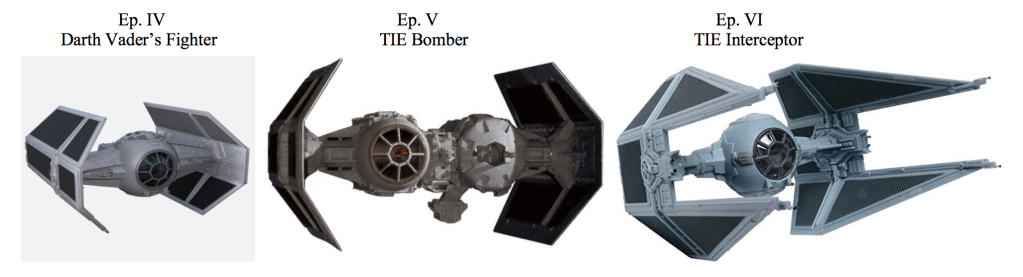
Where Lucas pushed for constant innovation, Disney opted for saving money. Their big design change was reversing the TIE Fighter’s color scheme from white to black! Black solar panels to white solar panels. White body to black body. Kylo Ren’s own ship in Episode VII is a hybrid of Vader’s ship and TIE Interceptor.

Context and time are part of Lucas’ worldbuilding. Disney ignores the elapsed time of thirty years between Episodes VI and VII! The very presence of Imperial fighters, X-Wings, Storm Troopers and the Millennium Falcon violates the constant innovation philosophy within existing canon.
In the OT and prequels, George Lucas made sure that his characters evolved by designing costume changes. The color pallet for Obi-wan Kenobi (a) and Luke (b) follow a similar path. Both characters begin in white, indicating their naiveté. In the second movie their costumes become shades darker expressing experience. But by their third appearance a divergence in color schemes is obvious. Obi-Wan’s trousers are darker and his under-tunic brown. Obi-Wan doesn’t question the Jedi Council. He doesn’t seek “answers”. He’s a good soldier who follows orders. That includes watching over Luke on Tatooine for the next nineteen years.

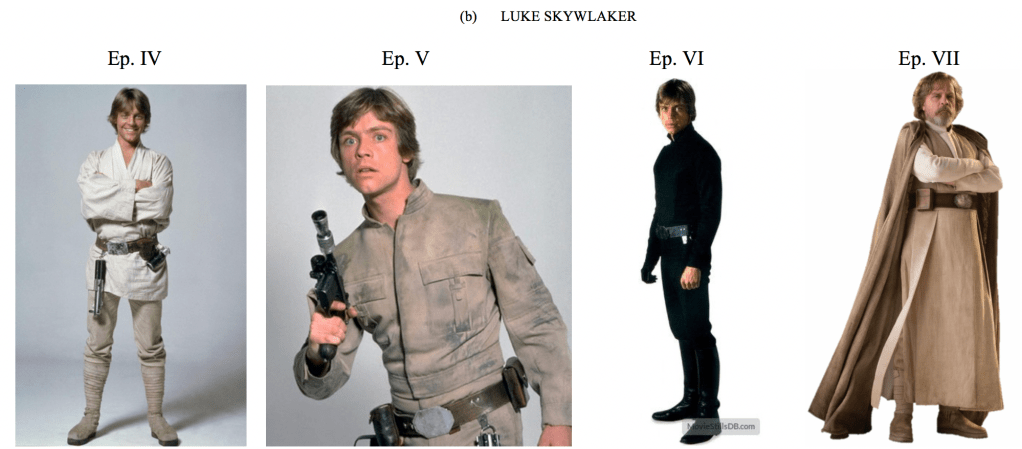
However, Luke was told the “truth” about his father in Episode V and so in Episode VI he’s dressed in black. Here the color black indicates “knowledge” rather than an obvious allusion to “evil”. As Chancellor Palpatine explains to Anakin in Revenge of the Sith,
“If one is to understand the great mystery, one must study all its aspects, not just the dogmatic narrow view of the Jedi. If you wish to become a complete and wise leader, you must embrace a larger view of the Force . . . Learn to know the dark side of the Force, and you will be able to save your wife from certain death.”
Knowledge is forbidden. In the Book of Genesis, Adam and Eve commit original sin by eating from the Tree of Knowledge. In Return of the JediLuke’s knowledge grows deeper, but his victory is refusing the Emperor’s temptation to join the Dark Side. Consequently, Abrams has him in Episode VII transition back into browns. This is not a total violation of character design, and his seclusion is the only thing that actually makes sense in TFA. Luke is now the wise man on top of the mountain. Despite getting Luke Skywalker correct, the design of Kylo Renn’s helmet is an aberration and obvious theft of Darth Vader’s samurai skull helmet. The difference is function. While Vader needed his helmet to breathe, Kylo’s mask serves no purpose.
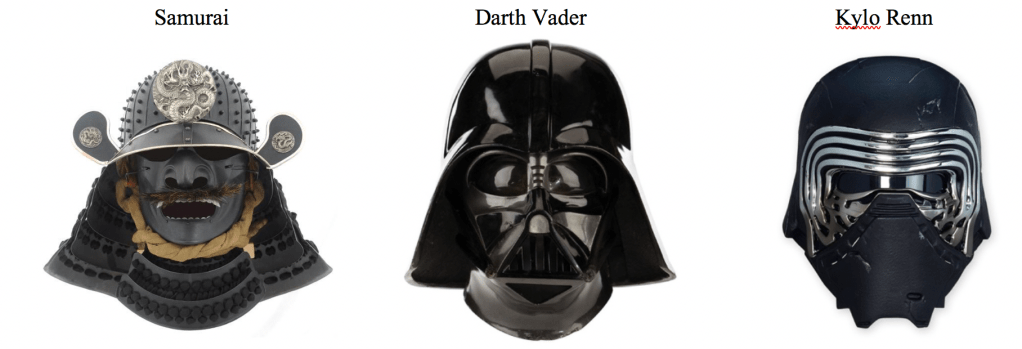
Renn’s visage is purely a marketing ploy by Disney to create toys and related merchandise for their theme parks. It is such a useless attempt to create something iconic that director Rian Johnson addresses the mask in his sequel The Last Jedi (TLJ). In Johnson’s script Supreme Leader Snoke commands Kylo Renn to “take that ridiculous thing off”. Later, after humiliated and berated for being a pathetic shadow of Darth Vader, Kylo smashes his helmet into an elevator panel. For the remainder of TLJ, he commands troops and fights Luke Skywalker without his “ridiculous” mask. The Force Awakenslack of design innovation is lazy and economically expedient for Disney, but an obvious attempt to remake or reboot the 1977 original.
A LONG TIME AGO . . .
There will definitely be no Episodes VII-IX. That’s because there isn’t any story. . . The Star Wars story is really the tragedy of Darth Vader. That is the story, Once Vader dies, he doesn’t come back to life. The Emperor doesn’t get cloned and Luke doesn’t get married. . .
George Lucas 2008 (Proctor 6)
As early as 1978 George Lucas had a metanarrative6idea that would consist of twelve movies. But between his divorce, finishing the OT, raising his kids, and making the prequels – his story had changed. Despite his strong feelings in 2008, he provided Disney an outline for Episodes VII – IX. But the CEO never intended to make George’s story (Iger). Michael Arndt was hired to write a new screenplay during pre-production. Later, J.J. Abrams was recruited by Kennedy to direct. But when veteran screenwriter Larence Kasdan (The Empire Strikes Back) joined Abrams, they threw out Arndt’s treatment (Handy). It was 2013 and pre-production was underway at Pinewood Studios without a roadmap!
According to Kasdan, “We were struggling to come up with a story. . . . We didn’t have anything . . . There were a thousand people waiting for answers on things, and you couldn’t tell them anything except ‘Yeah, that guy’s in it.’ That was about it. That was really all we knew” (Handy).
Kathleen Kennedy described the finished screenplay, “It’s sort of like going to a concert where you want to hear the new stuff that they’ve written, but really you want to hear some of the old songs. And we’re in a similar kind of thing: we’re getting the band back together, and we know that people are going to want to be reminded of the things they love, but they’re going to expect to have a new experience” (Handy).
The nostalgia was intentional. But worse, fanboy6pandering was included with Kasdan’s admission “What do we desperately want to see” (Handy)? The answer was apparently having Chewbacca use his laser-gun-crossbow or bowcaster. Then, a nod to the audience, Han Solo asks to use the bowcaster. “I like this thing”, winking at the audience. I’m just silently screaming inside.

Kasdan and Abrams concocted a story that is little more than a remake of Episode IV. It includes all the essential plot points of Lucas’ 1977 original Star Wars. A secret message inside a droid is lost on a desert planet where a parent-less hero lives. Han Solo avoids a debt collector but agrees to help. Worse is the inclusion of Anakin Skywalker’s lightsaber as a gift to our hero and the impossible task of attacking a Death Star like-planet, Starkiller Base, with X-Wing fighters flying into trenches. Not missing a beat, Abrams includes the sacrificial death of a mentor while the hero helplessly watches. And those are the blatant parallels in plot, ignoring similarities in conflict, setting and characters.
More egregious is the lack of a metanarrative by Abrams, Kasdan or Kennedy connecting the three movies. Rather, Abrams intentionally left the sequels to be constructed just as haphazardly as TFA. New directors could invent a new story for each sequel. This freedom allowed Rian Johnson to quickly dispose of Snoke and sacrifice Luke Skywalker in TLJ. If Abrams had a backstory for the evil master, it didn’t matter. Snoke and our hero, Luke, were just as disposable as the galaxy George created.
A GOOD QUESTION . . . FOR ANOTHER TIME.
The Force.Awakens ignores the pre-existing logic of Lucas’ universe. In the original 1977 film there is a constant thread of exposition explaining the political structure of the galaxy. From the opening crawl and Vader confronting Princess Leia, to Obi-Wan Kenobi mentoring Luke while General Grand Moff Tarkin explains the strategic role of the Death Star, Lucas maintains a familiar and coherent explanation of the political machinations in this galaxy far, far away.
Outside of TFA’s opening crawl J.J. Abram’s screenplay fails to provide any exposition outlining the galaxies current political structure. Why does New Republic and the Resistance coexist? Didn’t the Rebellion win the war? What exactly are they resisting? Is the Resistance an unsupported military arm of the New Republic? Why is the New Republic at risk of being toppled by outside forces?
This confusion leads Rian Johnson to conflate the two in TLJ. Why are they barely surviving to defend the New Republic from the unstoppable, yet marginalized First Order? Moreover, how does the First Order finance Starbase Killer, fleet of warships, weapons and legion of unlimited soldiers? None of it is explained.
The most critical continuity error Abrams makes is the inclusion of two OT artifacts. In his story they emit energy to Force sensitive Rey and Kylo. But inanimate objects, in this case a light saber and helmet, emitting energy is something completely invented by Abrams. It simply doesn’t exist in canon. In the Empire Strikes Back(ESB) Yoda explains to Luke the nature of the Force.
“Life creates it, makes it grow. Its energy surrounds us and binds us. Luminous beings are we, not this crude matter. (pinching Lukes fleshy shoulders). You must feel the force around you; here, between you, me, the tree, the rock, everywhere, yes. Even between the land and the ship”.
Anakin’s lightsaber was lost on the gas giant planet, Bespin in ESB. In TFAit’s used to connect the hero Rey with the Jedi hermit Skywalker. Forget that Luke lost it, with his hand, in the enormous air shaft of Cloud City venting out into the Tibbana gas below. How was it recovered?
“A good question – for another time,” is the only answer Maz Kanata gives Han Solo in TFA. Conveniently, this Yoda-stand-in character never provides an explanation. Rian Johnson obviously saw the stupidity in this illogical contrivance. He has Rey present the lightsaber to Luke in TLJwhere he irreverently tosses it over his shoulder like garbage.
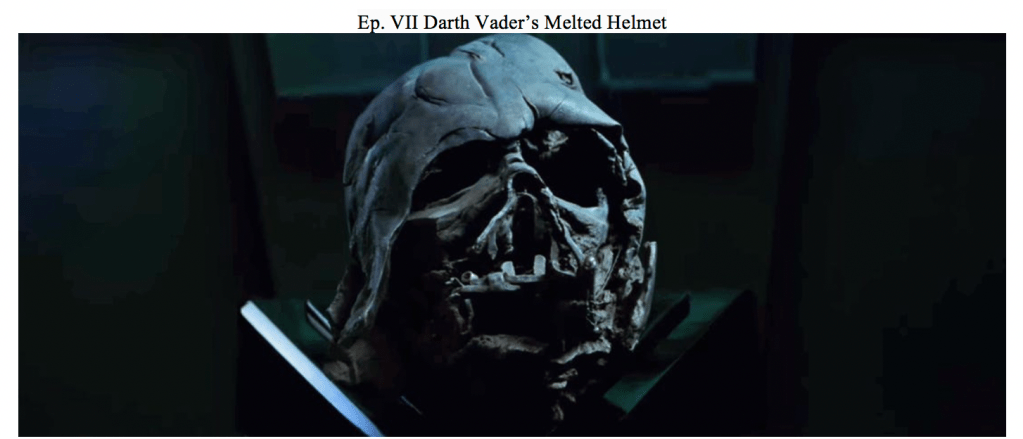
Just as ridiculous is Kylo Renn’s shrine to Darth Vader. Luke cremated his father in a funeral pyre on the moon of Endor in Return of the Jedi. Apparently Kylo Renn was drawn to Vader’s melted helmet by it’s “dark energy”. Is this supposed to explain why he wears his own “Ridiculous” mask? This obsession with Darth Vader by Kylo and Snoke is fundamentally misguided and illogical. Why not worship the true master of the Dark Side, Emperor Palpatine, rather than his flunkie?
Online critics of The Force Awakenslist multiple plot holes and explore countless continuity errors. The most flagrant fouls include Rey’s ability to jump-start a derelict Millenium Falcon, Kylo using the Force to read Rey’s mind, Rey understanding Wookie, Rey being able to use the Force like a Jedi master without any training, and Starbase Killer destroying multiple planets simultaneously by splitting it’s hellish laser into five destructive beams. The miraculous survival of Resistance pilot Po is absurd and inexplicable “awakening” of R2D2 was probably supposed to mean something, but it doesn’t. The most egregious violation is the lack of character development for Leia and Han Solo. After thirty years neither evolved. Worse, Han devolved into the Episode IV scoundrel audiences once loved.
DO OR DO NOT. THERE IS NO TRY.
Abrams did not design a movie around a metanarrative to span three movies. Rather, Robert Iger’s purpose was rebooting a franchise using nostalgia to recoup the $4 billion investment (Whitten). The biggest risk J.J.Abram’s story takes are introducing three new characters as his central protagonists. Each are on a personal quest. Rey seeks her parents, Kylo wants to be Darth Vader, and Finn is on the run for his freedom from the First Order. All three may each be an interesting story, but Abrams had no idea how to resolve them by Episode IX. Rather, Rian Johnson was free to take this “ridiculous” beginning and make an equally preposterous sequel.
In 2017, JJ Abrams was recruited by Kathleen Kennedy to finish the trilogy after dismissing another director. He agreed to make the movie, already in preproduction, without having a story (Sharf). Abrams was now confronted with the daunting task to invent an ending he never actually planned to write.Ultimately, George Lucas himself was invited to help make sense of this mess. (McMillan). In May of 2019 online rumors suggested he was involved in re-editing the film due to poor audience test-screenings (McGloin).
Despite the Walt Disney Company’s financial success with this trilogy and the Star WarsStory Group’s efforts to maintain continuity, TheForce Awakensand the sequels are fanfiction. Non-canon.
As Abrams admitted in his 2019 Vanity Fairinterview, “Fuck it, I’m going to do the thing that feels right because it does, not because it adheres to something.” (Grossman).
None of it adheres to anything! So, enjoy The Rise of Skywalker, a movie that stands for nothing.
NOTES
- Canon in this essay refers to G-canon or “George Lucas canon”. That means material accepted as officially part of the story in the Star Wars universe whereby continuity of details were exclusively created or approved by George Lucas (the Maker). His movies and related tv series override all other media material. Since Disney purchased Lucasfilm it established the Star WarsStory Group to define the canonicity of past and future stories.
- Expanded Universe began in 1977 with the publication of the novel Splinter of the Mind’s Eyeby Alan Dean Foster. Both Marvel and Dark Horse acquired the rights to publish comics and then various book series were published. These stories were considered C-Canon or Continuity Canon and included stories about Luke Skywalker marrying Mara Jade. Disney’s Story Group correctly determined this material as non-canon.
- Fan Fiction is a type of literature or film created by enthusiastic fans who desire to explore alternate narratives for the purpose of fulfilling their need to “expand the boundary of the official source.” (Bacon-Smith)
- For the purpose of this essay “fanservice” refers to material in a work of fiction or in a fictional series which is intentionally added to please the audience. (de la Ville. 45-57). Princess Leia’s slave bikini sequence in Return of the Jedi is an example George Lucas using fanservice.
- George Lucas expressed his unhappiness during an interview with Charlie Rose in 2015. He specifically identified the design decisions made by Disney by stating, “I worked very hard to make them (Star Warsmovies) completely different, with different planets, with different spaceships – you know, to make it new” This intentional design decision was part of Lucas’ world building. (Child, “Attack of the moans”)
- Fanboys are frequently portrayed as “angry nerds”, over-aggressive, derogatory, and protective of the object of their obsession. Fanboys are passionate people who belong to a subculture obsessed with a hobby or interest which may include, but not limited to, comics, movies, sports, computers, games, or music(Anderson). In this case, J.J. Abrams himself is an admitted fanboy of Star Warsand in the Vanity Fairarticles. Obviously, I’m a fanboy.
- Metanarrative is a story abouta story, encompassing and explaining other “little stories” within the whole. (Wolf`) Lucas assemble the “6 little stories” into a saga he describes as the “Tragedy of Darth Vader”.
WORKS CITED
Anderson, Lissley. “Fanboys: Have you ever loved something so much it hurt?”. The Verge, 21 January 2014.
Bacon-Smith, Camille. Science Fiction Culture. University of Pennsylvania Press. 2000. pp 112-113.
Child, Ben. “Will Kevin Feige’s Star Wars film spell the end for the George Lucas era?” The Guardian, 26 September 2019.
Child, Ben. “Attack of the moans: George Lucas hits out at ‘retro’ Star Wars: The Force Awakens,” The Guardian, 8 December 2015.
De la Ville, Valerie-Ines; Durup, Laurent. “Achieving a Global Reach on Childrens Cultural Markets: Managing the Stakes of Inter-Textuality in Digital Cultures”. In Willett, Rebekah; Robinson, Muriel; Marsh (eds.). Play, creativity and digital cultures. Routledge. 2009. Pp. 45-47.
Grossman, Lev. “Star Wars: The Rise of Skywalker, The Ultimate Preview” Vanity Fair, June 2019.
Handy, Bruce.“The Daring Genesis of J.J. Abrams’s Star Wars: The Force Awakens.” Vanity Fair, June 2015.
Iger, Robert.The Ride of a Lifetime: Lessons Learned from 15 Years as CEO of the Walt Disney Company. Penguin Random House. 2019. Pp. 183-188.
McMillan, Graeme. “Cantina Talk: George Lucas Worked on the Rise of Skywalker.” WIRED, 6 May 2019.
McGloin, Matt. “George Lucas Saving Star Wars; Test Screening ‘Disaster’” Cosmic Book News, 11 August 2019.
Proctor, William and Richard McCuloch, editors. Disney’s Star Wars: Forces of Production, Promotion & Reception. Iowa University Press, 2019.
Rogers, Adam. “Star Wars Fandom and the Immature Politics of Nostalgia,” WIRED, 4 May, 2019.
Sharf, Zach. “J.J. Abrams opens up about ‘Star Wars: Episode IX’ directing fears and signing on without a script” Salon. 10 April, 2019.
Whitten, Sarah. “Disney bought Lucasfilm six years ago today and has already recouped its $4 billion investment.” CNBC, 30 October 2018.
Whitbrook, James. “A Brief History of Star Wars Canon, Old and New”. Gizmodo. 2 February 2015.
Wolf, Mark J.P. Building Imaginary Worlds: The Theory and History of Subcreation. Routledge. 2014.
 Worldwide Ostii